

Organise + design your Reno with these resources
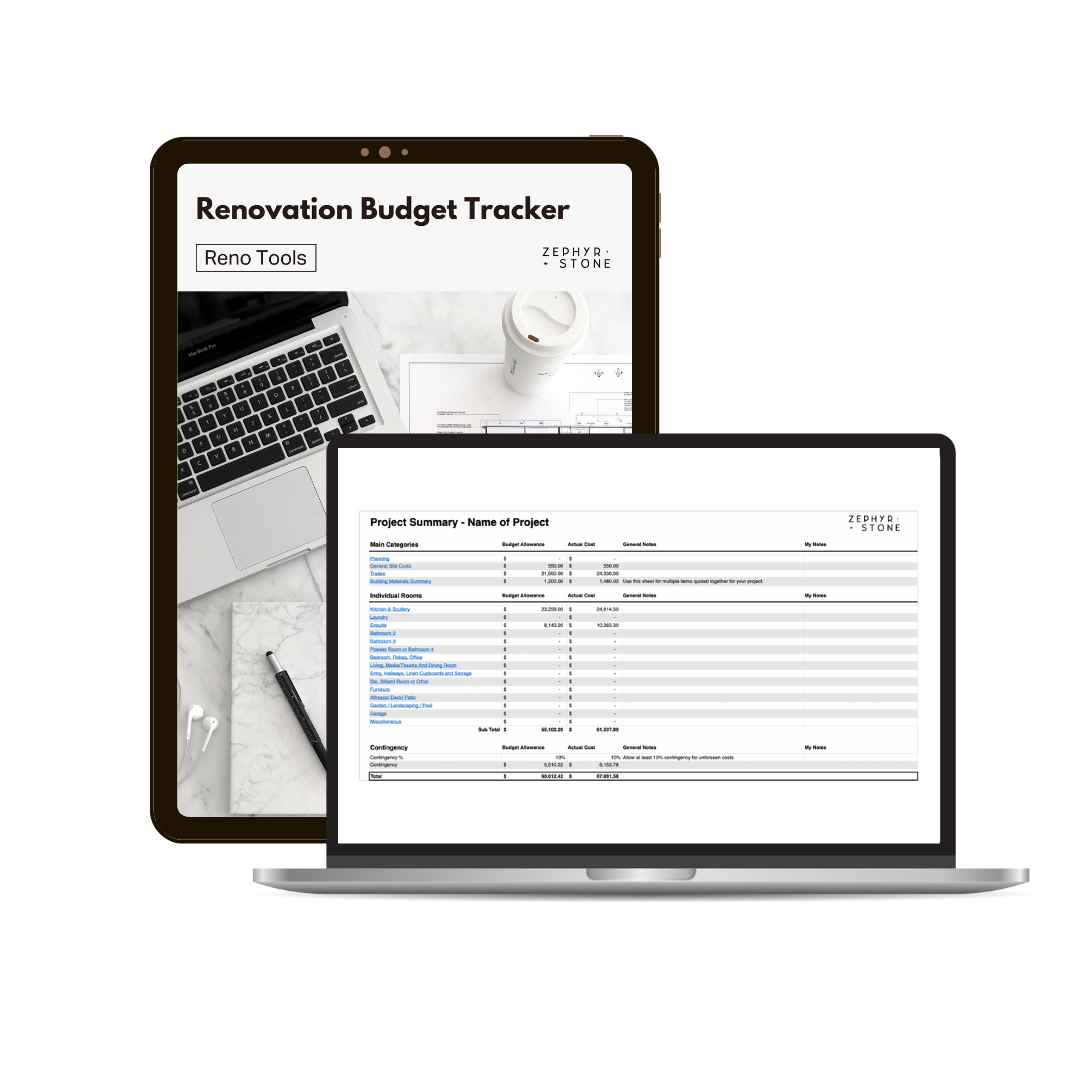
The Renovation Budget Tracker is a renovation budget template pre-loaded with over 200 items, from design fees and trades to tiles, tapware and furniture. It lets you plan your budget before you start, then track your real costs as quotes come in and you start paying. It totals everything for your whole renovation and for each room, so you always know where your budget stands.
What’s inside the tracker
You're never starting from a blank page. The items are grouped into 10 sections, each one a part of your renovation:
Planning and Site: design, approvals, demolition, skip bins and equipment hire
Builder, Trades and Materials
Cabinetry and Benchtops
Tiles and Flooring
Tapware, Sinks and Fittings
Electrical and Appliances
Windows, Doors and Blinds
Outdoor
Furniture
Other Costs
When a quote comes in, you know where it goes. A tile quote goes straight into Tiles and Flooring.
Every item has a place for your estimate while you plan, and your actual cost once you have a quote in writing or have paid. If the actual cost is higher than your estimate, it shows in red, so you see it the day the quote lands, not when the money's gone.
If a builder is quoting the whole job, their total goes in as one line, and you only add what isn't in their quote, like your appliances or furniture. Items you don't need stay empty.
Short notes beside some items point out the costs that are easy to forget, like asbestos testing in homes built before about 1990.
A summary page adds it all up for you, by section, by room and in total, with your estimate and your actual cost side by side. Each item can be given a room, like the kitchen or ensuite, so you see what each room is costing you. Your contingency, the money you set aside for surprises, is added to your total at the percentage you choose. All amounts are entered including GST.
Who it's for
The tracker works for homeowners renovating or building, whether you're working with a builder or managing the trades yourself.
It's built for you if:
You don't know what your project will actually cost.
You've started planning, and costs feel like they're getting out of control.
You're juggling quotes and need one place to track everything.
I built this tracker for my own renovations and developments. It's what I've used to keep every one of them on budget for around 20 years.
Kitchen, bathroom or whole home renovation budgets
It works for a single bathroom, a kitchen or a whole home, and for a renovation or a new build. If you're building, it also shows roughly how many square metres your budget can build.
Renovation budget template FAQs
Is the Renovation Budget Tracker an Excel spreadsheet? Yes. It works best in Excel on a computer. It also opens in Google Sheets and Apple Numbers, but some features may not work the same way.
Are prices included in the renovation budget template? No. You put in your own estimates and quotes, so the total is your project's real number, not an average.
How do I estimate renovation costs? List every item your project needs, then put an estimate against each one, using quotes where you have them. Then add a contingency for the unexpected. The Renovation Budget Tracker already lists over 200 items, so you start with the list. For typical figures, here's what a renovation costs in Australia.
How much contingency should I set aside? Set aside 10% for a new build or a home in good condition, 15 to 20% for an older home, and 20% or more for a heritage home or one in unknown condition. The tracker starts at 10%, and you can change it. Here's what to set aside in your renovation budget.
What happens after I buy? It's sent to your email straight away. Open it on the Start Here page, which shows you how it all works.
Can I get a refund? Yes, within 14 days. The details are in our terms and conditions.
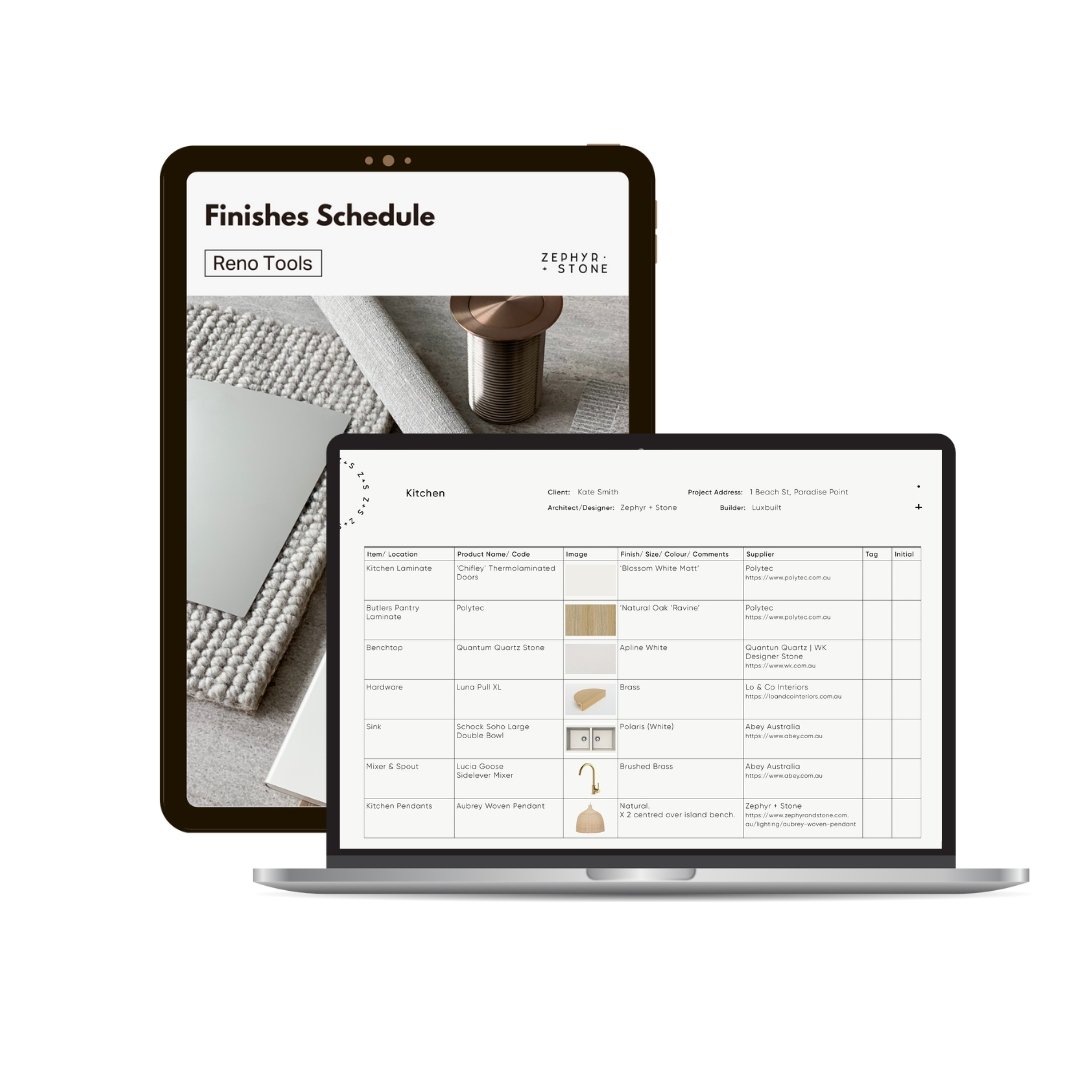
◾ #1 template for organising and managing your home renovation or building project
◾ Your Finishes Schedule is the QUICK + EASY way to store + keep track of all building products, fixtures + fittings, finishes + colours
◾Store the following home product details in your Schedule of Finishes to reference at any time during the planning stage and throughout your project —
✔️ Product names
✔️ Building product + product codes
✔️ Brand names
✔️ Colours, including material and paint colours
✔️ Product sizes, length and width dimensions
✔️ Supplier and manufacturer details, including websites and contact details
✔️ Any comments, installation notes or details for trades
✔️ Upload images of the product to visualise for trades and your building team
◾ Share your Digital Finishes Schedule with your builder, trades, architect… and other half or print it for handy reference onsite
◾ Store + edit your Finishes Schedule on your computer, phone or tablet to keep project details at hand, and quickly and easily reference or check product specifications during site visits and hardware shop runs
◾ Share your Finishing Schedule with your building team instantly at any time, and refer back to your schedule template for paint touch-ups or home improvements years from now
◾ Everyone always has access to the crucial details of your project, so nothing is missed.
◾ Use your finish schedule template for renovating one room or building your new home. Enter finishes + selections while you design and plan your project.
◾ It’s the tool that professionals like interior designers, builders + architects use, and now it’s yours!
◾ Includes a Prompt Sheet so you know exactly what products to include
◾ Template is used in the free version of Canva and can be used for this project and the next
MUST-HAVE project management tool for any home or DIY project — kitchen renovation, bathroom renovation, laundry renovation and everything in between — to save time, money and costly mistakes!
We’re often asked what carpet fibre we recommend and the answer is almost always wool. One of the overwhelming reasons is that it’s one of the most sustainable carpet choices for homes.
But what makes wool, or any product for that matter, sustainable? There’s actually a whole range of factors to take into account.
Here’s what you need to consider…

• Zephyr and Stone • Classic Coastal Walk in Robe featuring Cavalier Bremworth Transpire ‘Arise’ Wool Carpet

• Zephyr and Stone • Scandi Master Bedroom featuring Cavalier Bremworth Levante ‘Felucca’ Wool Carpet
Where Does It Come From?
This is the obvious one, right? The fibres a product is made from are going to be a major factor when it comes to sustainability. Is the material naturally sourced, man-made or made from recycled materials? All can have benefits.
Being a natural fibre makes wool sustainable as it can be naturally derived indefinitely. Opting for wool that is untreated or as close to its natural state as possible is the most sustainable option.
What’s Its Lifespan?
This is a vital question to ask when considering any new product for your home. Landfills and plastics in our oceans are silently becoming big environmental issues. By choosing quality products that stand the test of time, we can all reduce our carbon footprint.
On average, quality wool carpet has a minimum lifespan of 8 years, but more often than not lasts 20+ years. Its natural fibres make it extremely durable and less prone to compression compared to synthetic varieties. This results in a carpet that looks new for longer.

• Zephyr and Stone • Contemporary Coastal Walk in Wardrobe featuring Cavalier Bremworth Samurai ‘Kawa’ Wool Carpet

• Zephyr and Stone • Contemporary Coastal Walk in Wardrobe featuring Cavalier Bremworth Samurai ‘Kawa’ Wool Carpet
Is It Biodegradable?
This is a biggie…because no matter the lifespan of a product, it’s likely it will eventually end up as a landfill. If a product is biodegradable, it means it will decompose or to put it plainly, be eaten by bacteria and other living organisms and avoid ending up as pollution.
Wool is 100% biodegradable, and studies have shown it decomposes in both soils and a marine environment, leaving no nasty residues. This is a far cry from its synthetic counterparts, which can remain in landfills leaching toxic gasses and chemicals for generations.
Is it Renewable?
Finally, products that are renewable can be naturally replenished for generations to come. This is extremely vital as we endeavour to move toward a more sustainable future.
Wool fibres are more renewable when compared to most synthetic varieties, which makes them the obvious choice when it comes to sustainable homes.

• Zephyr and Stone • Classic Coastal Walk in Wardrobe featuring Cavalier Bremworth Transpire ‘Arise’ Wool Carpet
So in this age of environmental consciousness, wool carpets tick many important boxes. And better yet, they do so without any compromise on style.
But whether it’s home or lifestyle products you’re choosing, try to consider these sustainability factors and weigh up each in your decision-making. In doing so, you’ll likely end up with more natural products and fewer plastics and synthetic fibres in your home and life!